Why Dialogue Intelligibility is One of the Most Important Parts of a Great Mix
In audio post-production, a great mix is never just about volume.
It is about balance, clarity, emotion, and making sure the audience can follow the story without working too hard. Whether it is a feature film, episodic television, documentary, commercial, corporate video, podcast, audiobook, or social content, one thing remains true across every format:
If the audience cannot clearly understand the dialogue, the message is at risk.
Dialogue intelligibility is one of the most important parts of any finished mix. It is also one of the most nuanced.
At BAM Studios, dialogue is at the center of much of what we do. From ADR and voiceover recording to sound design, mixing, restoration, and final delivery, our work is built around helping performances, stories, and brands come through clearly.
What Is Dialogue Intelligibility?
Dialogue intelligibility is the ability for the listener to clearly understand spoken words in a mix.
That may sound simple, but in practice, it involves many creative and technical decisions. Dialogue has to sit properly against music, sound effects, room tone, production noise, background ambience, and delivery requirements. A line that sounds clear in the studio may not translate the same way on a television, laptop, phone, streaming platform, theater system, or earbuds.
A strong mix helps dialogue feel natural and present without making it sound overprocessed or disconnected from the scene.
That balance is where experience matters.
Why Dialogue Clarity Matters
When dialogue is unclear, the audience notices quickly.
They may not know whether the issue is production sound, music levels, sound effects, compression, EQ, or the playback environment. They only know they missed a line, lost a detail, or had to turn the volume up and down.
That moment can pull them out of the story.
For narrative work, dialogue carries performance, character, plot, and emotion. For documentary content, it carries information, context, and authenticity. For advertising and branded content, it carries the message. For podcasts and audiobooks, it is often the entire experience.
A mix can be creative, cinematic, and dynamic, but it still has to communicate.
The Challenge of Modern Listening Environments
Today’s content is heard everywhere.
A finished mix may be played on a calibrated studio system, but it will also be heard through smart TVs, mobile phones, tablets, laptops, car speakers, soundbars, earbuds, and small Bluetooth speakers.
That range of playback environments makes dialogue intelligibility even more important.
A mix that only sounds good in one room is not enough. The dialogue needs to translate across real-world listening conditions while still meeting professional standards for broadcast, streaming, theatrical, digital, social, and internal brand use.
At BAM, we are constantly thinking about that translation. The goal is not simply to make dialogue louder. The goal is to make it clear, natural, and properly supported by the rest of the mix.
It Is Not Just a Technical Issue
Dialogue clarity is technical, but it is also creative.
Sometimes the right choice is subtle EQ. Sometimes it is noise reduction. Sometimes it is adjusting music or effects around the spoken word. Sometimes it is rebuilding a scene with ADR, room tone, Foley, sound design, or carefully shaped ambience so the dialogue can live naturally in the environment.
In advertising, a voiceover may need to cut through music and sound design while still feeling warm and polished. In film and television, a whispered line may need to stay intimate without disappearing. In documentaries, an interview recorded in a difficult location may need careful restoration without losing the personality of the speaker.
Every project is different.
That is why dialogue intelligibility cannot be treated as a preset. It takes judgment, experience, and a deep understanding of how all the elements of a mix work together.
BAM’s Approach to Dialogue and Mixing
BAM has been working in audio post-production for more than 25 years, with senior team experience that reaches back nearly four decades across recording, mixing, ADR, voiceover, sound design, and broadcast production.
Our team understands dialogue from multiple angles. We record it, edit it, clean it, match it, replace it, cast it, direct it, and mix it.
That full-picture understanding is a major advantage.
When we are mixing a project, we are not just reacting to dialogue problems at the end of the process. We understand how those issues often begin, how to solve them, and how to keep the final piece feeling seamless.
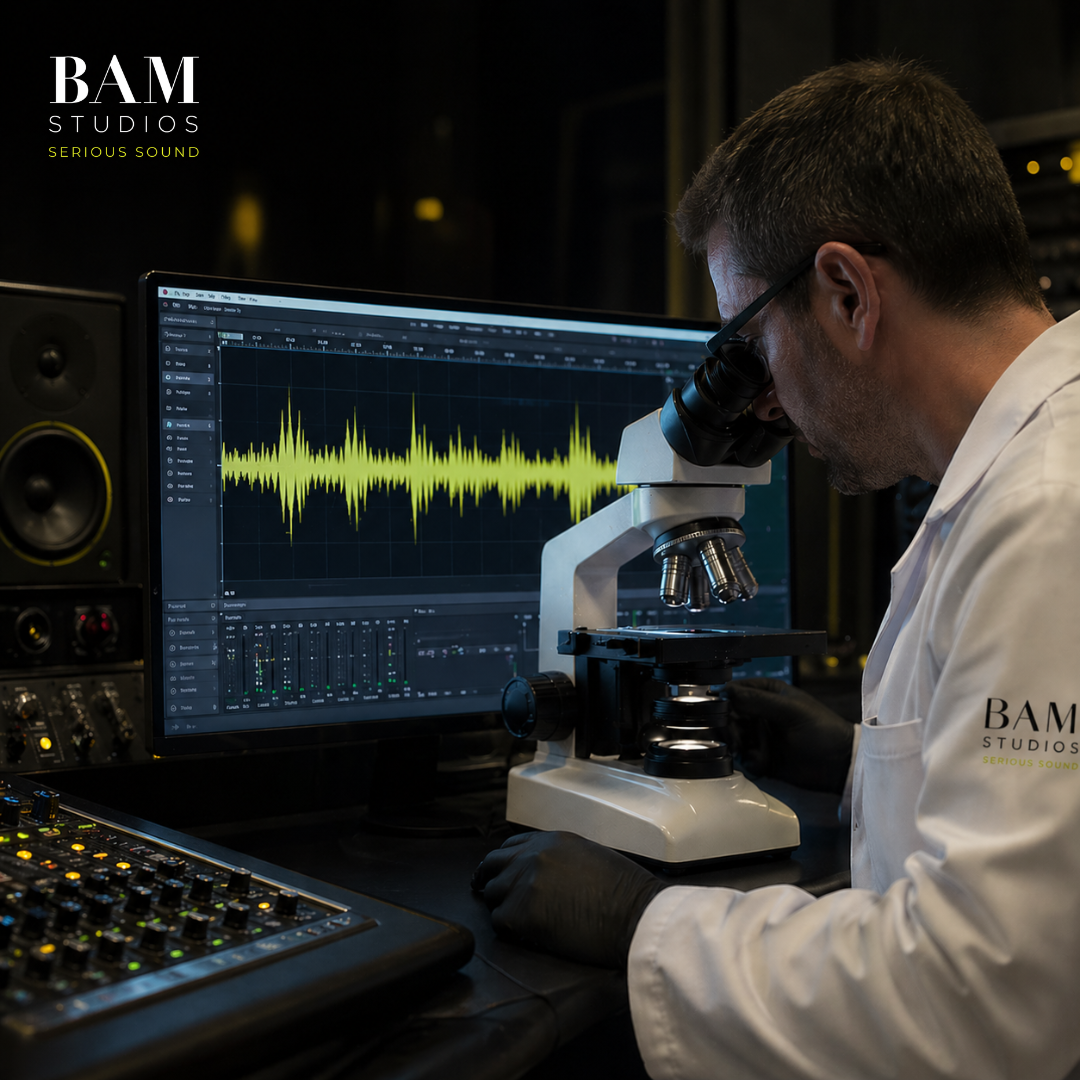
Our engineers work in professionally designed rooms built for critical listening. That matters. A proper mixing environment allows us to make accurate decisions about level, tone, space, dynamics, and translation.
But the room is only part of it. The bigger difference is the team.
BAM’s audio engineers bring years of experience working with directors, producers, agencies, networks, studios, editors, and brands. We know how to protect the creative intent while making sure the final product is clear, polished, and ready for delivery.
Dialogue Should Feel Effortless
The best dialogue work is often invisible.
The audience should not be thinking about EQ, noise reduction, ADR matching, compression, or loudness standards. They should simply hear the words, understand the story, and stay connected to the content.
That is the goal.
When dialogue is mixed well, it feels effortless. The voice sits where it should. The music supports it. The sound design adds impact without getting in the way. The final mix feels complete.
At BAM, that level of detail is part of the process.
Whether we are mixing a television episode, a national commercial, a documentary, a podcast, an audiobook, a corporate film, or a digital campaign, dialogue intelligibility is always a priority.
Because clear dialogue is not just a technical requirement.
It is how the story gets heard.
By Brian Reed
President & CEO, BAM Studios
May 6th, 2026
BAM Studios is a Chicago-based audio post-production company specializing in sound mixing, ADR, voiceover recording, sound design, podcast production, and immersive audio for film, television, advertising, and digital media.